Today we drove from Port Augusta to Coober Pedy. Just out of Port Augusta we visited the Australian Arid Lands Botanic Gardens and stood where Matthew Flinders stood at the head of Spencer Gulf during his circumnavigation of Australia in the early 1800's.
We then stopped off at Woomera and see some of the early rockets which were launched from there since 1947.
Then it was on to Coober Pedy where we watched a beautiful sunset at The Breakaways about 30kms North of Coober Pedy.
There has been a bit of rain up this way so there is a good tinge of green about the place and it looks pretty spectacular. The flies were very friendly today so I am glad I brought the fly net with me.
Tomorrow we have a flight over Lake Eyre so I am really looking forward to that.
Bye for now
David Petherick
Wednesday, 27 April 2011


Larapinta Trail Charity Challenge
Well we are on our way to Alice Springs for the start of the 7 day Larapinta Trail walk on Sunday. My wife Mary and I are walking the trail to raise money for our respective charities. I am walking for People Outdoors, our disability respite program, and Mary is walking for our Chilean Women's Charity La Leona. It is a big country and a long drive but we also think it is a great way to gain some appreciation of just how big Australia is. The return trip from Geelong to Alice Springs is about 4,800kms!
On Monday we stopped in on the famous Stawell Gift Athletics Carnival to watch a few races and soak up the atmosphere. We also passed the Big Koala at Dadswell Bridge - there does seem to be a period in our not to distant past that we built a whole lot of "Big" things?
We then travelled on to Bordertown and visited former Prime Minister Bob Hawke's birthplace and the first house he lived in before spending the night in Murray Bridge.
Tuesday started with breakfast by the Murray River on a beautiful Autumn day and was followed by a very pleasant day in the Barossa and Eden Valley wines regions for Harvest Festival. We even spotted Maggie Beer at the Harvest Market at Yalumba Winery. We did manage to pick up a few nice bottles of red to sustain us on the trip as well!
Spent the night in Port Augusta and today we head off into outback Australia on our way to Coober Pedy for a couple of nights.
Australia really is a beautiful country and there is so much to see if only we make the time to see it. We really need to do this more often as it is a great way to recharge the batteries and to step back and take time to think. We need to keep encouraging all Australians to spend more time outdoors.
Well, onwards and upwards.
David Petherick
On Monday we stopped in on the famous Stawell Gift Athletics Carnival to watch a few races and soak up the atmosphere. We also passed the Big Koala at Dadswell Bridge - there does seem to be a period in our not to distant past that we built a whole lot of "Big" things?
We then travelled on to Bordertown and visited former Prime Minister Bob Hawke's birthplace and the first house he lived in before spending the night in Murray Bridge.
Tuesday started with breakfast by the Murray River on a beautiful Autumn day and was followed by a very pleasant day in the Barossa and Eden Valley wines regions for Harvest Festival. We even spotted Maggie Beer at the Harvest Market at Yalumba Winery. We did manage to pick up a few nice bottles of red to sustain us on the trip as well!
Spent the night in Port Augusta and today we head off into outback Australia on our way to Coober Pedy for a couple of nights.
Australia really is a beautiful country and there is so much to see if only we make the time to see it. We really need to do this more often as it is a great way to recharge the batteries and to step back and take time to think. We need to keep encouraging all Australians to spend more time outdoors.
Well, onwards and upwards.
David Petherick
Sunday, 6 February 2011
San Diego dreaming
Well I am here in San Diego posting this blog in the bathroom of my hotel room (so as not to wake my fellow traveller who arrived yesterday) at 1am. Perhaps this means that I may still be slightly jet lagged!
This morning we are off on a tour of camps prior to the American Camp Association National Conference getting underway on Tuesday. It is also Superbowl Sunday here so I am hoping we can find a sports bar to watch the game and get into the atmosphere a bit (go Steelers - who I discovered today have yellow and black as their colors and so are as good as a sister team to the mighty Richmond Tigers).
I am also reminded of a conversation I had with Don MacDowall back in 2008 when I suggested that a blog might be a good idea for the Australian Camps Association and he agreed but suggested that the biggest challenge would be finding the time to post regularly! I think it is now safe to say we have put that argument to bed.
Time for me to go back to bed and try to catch up on my sleep as my legs have pins and needles!
More tomorrow.
Dave P
This morning we are off on a tour of camps prior to the American Camp Association National Conference getting underway on Tuesday. It is also Superbowl Sunday here so I am hoping we can find a sports bar to watch the game and get into the atmosphere a bit (go Steelers - who I discovered today have yellow and black as their colors and so are as good as a sister team to the mighty Richmond Tigers).
I am also reminded of a conversation I had with Don MacDowall back in 2008 when I suggested that a blog might be a good idea for the Australian Camps Association and he agreed but suggested that the biggest challenge would be finding the time to post regularly! I think it is now safe to say we have put that argument to bed.
Time for me to go back to bed and try to catch up on my sleep as my legs have pins and needles!
More tomorrow.
Dave P
Friday, 8 October 2010
Respecting nature
Last weekend I had the privilege to attend Bob Cooper's Wilderness Survival Course at the Anglesea Recreation Camp here in Victoria, Australia. One of the key things Bob and his offsider talked about was respect for the bush.
This was in the context of walking gently on the earth and taking only what you need and also respecting nature enough to understand the potential consequences of being unprepared and making poor decisions whilst in the bush.
We heard many stories of people who perished in the harsh Australian outback because they did not show enough respect for environment they were travelling in.
On the course I learned and had the opportunity to practice some basic bushcraft skills such as navigating - with and without a compass - finding and collecting water and I even learned to start a fire from materials found in nature (yes including sticks).
In fact what I really learned was how little I knew and how unprepared I was previously.
But the main thing I learned was respect for the environment and even though I have some new found bush survival skills this does not mean that I will be blundering off into the bush Bear Grylls style eager to demonstrate my new skills - quite the opposite. I do plan to spend more time in the bush but I will actually be more cautious, respectful and prepared because the best approach is to avoid the need to use my new survival skills in the first place.
Wednesday, 2 December 2009
Fear and anxiety
One of my favourite quotes is by Dan Gardner (Risk. The Science and Politics of Fear, 2008) who said that "we are the healthiest, wealthiest, and longest-lived people in history. And we are increasingly afraid. This is one of the great paradoxes of our time."
This manifests itself in a number of ways. I am bothered by how many times I hear statements such as "we have had legal advice and we can't...". This bothers me particularly when it stops us from giving advice that we genuinely believe to the correct advice based on experience and the best knowledge at our disposal.
An example of this emerged after the terrible bushfires we had here in Victoria last February. I read about one local council that said they wanted to put in bunkers in their community but didn't because they could not indemnify themselves against any future claims. Leaving aside whether we think bunkers are a good idea in bushfire prone areas, what we seem to have here is a council that believes they are the best protection for their residents - but who can't or won't put them in because of the legal/insurance problems that they might cause.
While I understand their reticence, I am concerned that they felt they were unable to implement a policy that they felt provided the best protection for their residents because of what a court might do in the future.
This approach is now entrenched as the default position. Decisions made not based on what the best policy is in a given situation, but on whether the decision maker can shift the risk to someone else - and in this context I am talking about legal risk (liability) not actual risk.
When and how did this happen? It is all pervasive and I suspect it has snuck up on us.
I want to be clear that I am not advocating recklessness here - but the pendulum has swung too far in seeking to apportion blame for every accident and incident in society. Yes we want to learn from mistakes that are made and where it is proved that negligence caused the incident then yes there should be consequences. But when we as a society become afraid to do what we believe to be right because we are so concerned with being legally liable - then we have surely gone too far.
This manifests itself in a number of ways. I am bothered by how many times I hear statements such as "we have had legal advice and we can't...". This bothers me particularly when it stops us from giving advice that we genuinely believe to the correct advice based on experience and the best knowledge at our disposal.
An example of this emerged after the terrible bushfires we had here in Victoria last February. I read about one local council that said they wanted to put in bunkers in their community but didn't because they could not indemnify themselves against any future claims. Leaving aside whether we think bunkers are a good idea in bushfire prone areas, what we seem to have here is a council that believes they are the best protection for their residents - but who can't or won't put them in because of the legal/insurance problems that they might cause.
While I understand their reticence, I am concerned that they felt they were unable to implement a policy that they felt provided the best protection for their residents because of what a court might do in the future.
This approach is now entrenched as the default position. Decisions made not based on what the best policy is in a given situation, but on whether the decision maker can shift the risk to someone else - and in this context I am talking about legal risk (liability) not actual risk.
When and how did this happen? It is all pervasive and I suspect it has snuck up on us.
I want to be clear that I am not advocating recklessness here - but the pendulum has swung too far in seeking to apportion blame for every accident and incident in society. Yes we want to learn from mistakes that are made and where it is proved that negligence caused the incident then yes there should be consequences. But when we as a society become afraid to do what we believe to be right because we are so concerned with being legally liable - then we have surely gone too far.
Friday, 10 July 2009
Are we raising our children to be frightened?
I was recently in the airport waiting to fly home when I heard a mother yell at her daughter, who was about 5 years old, "don't wander away or you will get snatched (kidnapped), kids get snatched all the time you know". The child had moved about 2 metres away from her mother and the comments really grated on me. Maybe we have always invoked the bogeyman to get our children to do what we want them to - but I am not sure it is either effective or appropriate.
Apart from this not being true (kids getting snatched all the time that is) - it did make me think about how much we as a society focus on fear. This is particularly important for us in Victoria after the tragic bushfires of 7 February this year.
With the experts telling us that climate change means we can expect more extreme weather events in the future, there is the very real possibility that we may have a public loss of confidence in the bush. If this leads to even more people staying at home on their PlayStation's or Nintendo instead of getting outside then I think the long term consequences will far outweigh the actual risk of being outdoors in nature.
To respond to this heightened anxiety we will need to focus on the benefits that come from being involved in outdoor programs, while at the same time being able to demonstrate that as an industry we have responded to the changing environment and that we have taken all reasonable steps to ensure our programs are safe and that we have reviewed and revised our programs accordingly.
Apart from this not being true (kids getting snatched all the time that is) - it did make me think about how much we as a society focus on fear. This is particularly important for us in Victoria after the tragic bushfires of 7 February this year.
With the experts telling us that climate change means we can expect more extreme weather events in the future, there is the very real possibility that we may have a public loss of confidence in the bush. If this leads to even more people staying at home on their PlayStation's or Nintendo instead of getting outside then I think the long term consequences will far outweigh the actual risk of being outdoors in nature.
To respond to this heightened anxiety we will need to focus on the benefits that come from being involved in outdoor programs, while at the same time being able to demonstrate that as an industry we have responded to the changing environment and that we have taken all reasonable steps to ensure our programs are safe and that we have reviewed and revised our programs accordingly.
Tuesday, 11 November 2008
I am home
Well I have arrived safely back in Australia (a couple of weeks ago) and I am at the stage now that when I wake up I don't wonder what city I am in - I am home.
I had a great trip to Canada - what a beautiful country - and then on to New England for a short visit - more beautiful countryside and Autumn colours. The hospitality we encountered was first class and I had the opportunity to meet and learn from lots of wise and knowledgeable colleagues while we were there.
I know look forward to opportunities to share what I learned to our colleagues in Australia and hopefully we can implement a number of the ideas we have picked up.
I even bought some cookies from a young woman working for the Obama campaign in New  Haven and so I feel that I made a contribution to his election.
 Haven and so I feel that I made a contribution to his election.
I also couldn't resist the chance to get myself involved in a debate between Republicans and a lone, but quite passionate, Democrat in New York. That is me on the left of the photo in my 'Mystic Journey' tee shirt.
The 'Mystic Journey' was a bit of a theme for me for the whole trip - I bought the tee shirt in Vancouver in Stanley Park at the start of the trip and used it to remind myself to try to stay 'in the moment' throughout - to fully listen to what I was being told and to learn as much as I could - hopefully I was able to do that at least most of the time.
Tuesday, 7 October 2008
Day Camps, Montreal

We also visited day camps in Montreal at the Bio Dome and the Montreal Botanic Gardens.
The Bio Dome (above right) is like a zoo and they run a range of activities around animal themes and conservation. The campers complete conservation projects and learn about eco systems and biodiversity.
At  the Montreal Botanic Gardens campers also undertake projects around themes like geology, plants or insects.
 the Montreal Botanic Gardens campers also undertake projects around themes like geology, plants or insects.
They even have an opportunity to plant and tend their own veggie garden over the 7 week Summer program. They then harvest and take home the produce.
Base de Plein Air le P'tit Bonheur

This camp was founded by the Jesuits in 1962 and is on 1700 acres with 6 lakes (I am convinced it is illegal in Canada to open a camp without at least one beautiful lake.)
They use tee pee accommodation and log cabins and are in the process of trying to raise $24million over 5 years to upgrade the camp.
They have a range of programs focused on young people who have dropped out of school to try to get them to go back to school.
These campers spend 2 weeks at school learning skills like cooking or maintenance and then come to camp for 2 weeks to put those skills into practice.
Base de Plein Air Perce-Neige, Quebec
Our host at this camp was Yanik Villeneuve or Kuma (the Bear in Japanese). This camp was opened in 1977 and is owned and supported by the Canadian Tire Foundation (Canadian Tire is like Bunnings in Australia.)
This is part of the gang at left after our morning hike to the lookout.
They run a range of programs for people with a disability and disadvantaged groups, as well as school programs and Summer camp for 8-15yo.
The foundation is made up of the 94 stores in Quebec who each contribute a percentage of their profits to the foundation.
It would be great if we could get the level of involvement with the corporate sector that they have in Canada.

This is part of the gang at left after our morning hike to the lookout.
They run a range of programs for people with a disability and disadvantaged groups, as well as school programs and Summer camp for 8-15yo.
The foundation is made up of the 94 stores in Quebec who each contribute a percentage of their profits to the foundation.
It would be great if we could get the level of involvement with the corporate sector that they have in Canada.
Sunday, 5 October 2008
More about germs
In relation to my last post I found this little item for sale in my airline magazine:
"A personal germ eliminator" which apparently uses portable UVC light to kill 99.99% of germs. They recommend you use it to sterilise telephones, keyboards, bathroom services (I assume this is the dunny seat!), hotel pillows, kitchen utensils and more - now come on!
"A personal germ eliminator" which apparently uses portable UVC light to kill 99.99% of germs. They recommend you use it to sterilise telephones, keyboards, bathroom services (I assume this is the dunny seat!), hotel pillows, kitchen utensils and more - now come on!
Kamp Kanawago, YMCA, Quebec
 Our first camp visit in Quebec and thank you to Sean Day for delaying his reunion with his wife after a long Summer to show us around (our apologies to his wife for keeping him).
This was a camp on a beautiful setting. They have a significant focus on environmental sustainability. I was very excited to see the organic veggie garden at the entrance. Surely if they can have veggie gardens at camps in Canada with long frozen Winters, then we can have them in Australia where we can grow veggies all year round!

They also had a new toilet and shower block (above right) with composting toilets and the ability to recycle the waste water from the showers and basins via a natural filtering system (below right).
Their hot water is heated by timber from tree falls on their property and they have an extensive composting program.
Next year they plan to incorporate programs about this in their Summer Camp program - each camper will have at least 6 hours of environmental programs during a 12 day/11 night program.
I believe with an increasing focus on the environment and global warming this is the way for us to go - it would be fantastic if we good run programs which teach our campers about food miles and carbon footprints and healthy eating and where our food comes from.
We will continue to seek discussions with government in Australia about supporting these kinds of programs.
Tuesday, 30 September 2008
Farewell Circles and the Management of Risk
I had a bit of a sleepless night the other night thinking about the images I had seen of the Farewell Circle at Camp Wenonah. These were emotional and touching images of campers and staff who had clearly developed strong friendships over the Summer, saying goodbye to each other. Images of perfectly healthy, natural and human responses.
And yet I couldn't help but feel that the Farewell Circle would be an unlikely part of programs in Australia, or at the very least it would not involve the staff, because one of the ways we have responded to abuse of young people in Australia (and in many other places I am sure) has been to make it socially unacceptable for adults, particularly males, to hug children. The intention of this is, of course, to protect our children and this is a sensible and reasonable thing for a society to do. But I wonder if the solution causes other problems for young people.
I believe there are similar dynamics at play in other areas of society and not just in Australia of course. In an attempt to protect our children against injury we increasingly focus on the elimination of risk. Maybe, despite the evidence about the dangers of a sedentary lifestyle, this leads us to prefer our children watch television or play computer games in the lounge room where we can keep them 'safe' rather than be out riding bikes or climbing trees in what we perceive to be the dangerous outdoors.
But at what cost to their healthy development into adulthood, to their levels of resilience and to their long term physical and mental health?
Next time you see an advertisement for household disinfectant look closely at what they are really saying - and they are mostly not being too subtle about it either - germs are bad, if you really love your family then you will use our product in copiuos quantities to kill all the germs in your house.
But apart from this being a fruitless exercise, what impact is this having on our immune systems? On the environment? Is it coincidental that the more sterile our lives become the more we see allergies emerge?
I don't think there are simplistic answers to any of these questions. I am not advocating that we all just start hugging each other again, or that we let our kids run wild, or that we stop cleaning our houses. I believe it was simplistic solutions that got us into this mess. I think it went something like this:
1. Our children are at risk.
2. Hands up all those people who don't want to protect our kids.
3. Good, so everyone (except bad people who don't care about our kids) wants us to take all measures to protect kids.
I don't have the answers but I am troubled by many of the 'solutions' we have now and I think we need to keep examining these things in an effort to come up with better ways. I am convinced that these are not simple problems with simple answers. If they were then they would have been solved a long time ago and clearly they have not been. Logically this must mean they are in fact, like most issues, complex and nuanced - shades of grey rather than black and white.
But I am confident that if we continue to talk together and to look for better solutions then we will eventually find them.
And yet I couldn't help but feel that the Farewell Circle would be an unlikely part of programs in Australia, or at the very least it would not involve the staff, because one of the ways we have responded to abuse of young people in Australia (and in many other places I am sure) has been to make it socially unacceptable for adults, particularly males, to hug children. The intention of this is, of course, to protect our children and this is a sensible and reasonable thing for a society to do. But I wonder if the solution causes other problems for young people.
I believe there are similar dynamics at play in other areas of society and not just in Australia of course. In an attempt to protect our children against injury we increasingly focus on the elimination of risk. Maybe, despite the evidence about the dangers of a sedentary lifestyle, this leads us to prefer our children watch television or play computer games in the lounge room where we can keep them 'safe' rather than be out riding bikes or climbing trees in what we perceive to be the dangerous outdoors.
But at what cost to their healthy development into adulthood, to their levels of resilience and to their long term physical and mental health?
Next time you see an advertisement for household disinfectant look closely at what they are really saying - and they are mostly not being too subtle about it either - germs are bad, if you really love your family then you will use our product in copiuos quantities to kill all the germs in your house.
But apart from this being a fruitless exercise, what impact is this having on our immune systems? On the environment? Is it coincidental that the more sterile our lives become the more we see allergies emerge?
I don't think there are simplistic answers to any of these questions. I am not advocating that we all just start hugging each other again, or that we let our kids run wild, or that we stop cleaning our houses. I believe it was simplistic solutions that got us into this mess. I think it went something like this:
1. Our children are at risk.
2. Hands up all those people who don't want to protect our kids.
3. Good, so everyone (except bad people who don't care about our kids) wants us to take all measures to protect kids.
I don't have the answers but I am troubled by many of the 'solutions' we have now and I think we need to keep examining these things in an effort to come up with better ways. I am convinced that these are not simple problems with simple answers. If they were then they would have been solved a long time ago and clearly they have not been. Logically this must mean they are in fact, like most issues, complex and nuanced - shades of grey rather than black and white.
But I am confident that if we continue to talk together and to look for better solutions then we will eventually find them.
Camp Walden, Ontario

Our final camp for Ontario was Camp Walden - our hosts Sol, Jen and Talia Birenbaum.
The activity at right is called the Whale Watch Board (I think) and involves a group of campers trying to balance the board without speaking. It is about two metres by three metres and looks a lot of fun.
This is a big camp and accommodates 500 campers and 250 staff in Summer. Most campers stay for the whole seven week program - this is at the upper end as far as camps we have visited so far.

At the end of a fantastic meal (a continuing theme so far) we were entertained by Dave Borins (sorry about the red eye Dave). Camp Walden has a very strong music program and Dave is a product of that program - keep your eye out for him he is destined for big things I am sure - and remember you heard it here.
Tomorrow we are off to Ottawa and then on to Quebec. Thank you to all those camp staff who have made us so welcome in Ontario (and Alberta and British Columbia before that).
Quirky Canada continued
Pets seem to provide an endless supply of mirth. Here are a couple of examples from Canadian print media.
"The Pet Ramp and Staircase" - carpeted. For when your dog is too old and arthritic to jump up on your bed or sofa to shed it's fur.
A solid pine "pet crate" to lock up your pet inside the house - but this one doubles as a "very stylish end table" - seriously.
And finally - "Butter Boy" - it is like a roll-on deodorant for your corn on the cob - only you fill it with butter - what will they think of next.
"The Pet Ramp and Staircase" - carpeted. For when your dog is too old and arthritic to jump up on your bed or sofa to shed it's fur.
A solid pine "pet crate" to lock up your pet inside the house - but this one doubles as a "very stylish end table" - seriously.
And finally - "Butter Boy" - it is like a roll-on deodorant for your corn on the cob - only you fill it with butter - what will they think of next.
Camp Tanamakoon, Ontario

Next stop in Ontario was Camp Tanamakoon in Algonquin Park. We got to this camp via a very pleasurable ride on a 'Huck Finn' motorised raft. The only other way into camp was via a walking track (which some of us took on the way out - very pretty and we spotted a grouse on the way out to boot).
I am not sure how much better the Autumn colour can get but the gang (at right) was obviously impressed.

This camp is an all girls camp and they have a range of great activities. They have a veggie garden that the campers help with and they also have the solar panels (at right) which provide all the power for lights and hot water.
They also make their own maple syrup and gave us a bottle each to take home with us (we also got some Tawingo maple syrup from Jorgie - thanks).
Camp Wenonah

Jeff Bradshaw was our host at Camp Wenonah and hats off to Jeff and his staff for our greeting. We were greeted by a table at the end of the floating dock (right) covered with fabulous food and beautiful Canadian wine and beer.
The lake that surrounded this spot was completely covered in trees in full Autumn colour and for us Australians the colours were more vibrant than any we had seen before.
This was the perfect way to start our last camp visit for the d ay and as you can see from the photo at right I was flat out working for our ACA members.
ay and as you can see from the photo at right I was flat out working for our ACA members.I believe I was drinking a Muskoka Dark Ale - and I can highly recommend it if you ever find yourself in this part of the world.
At the end of the camp tour Jeff showed us a slide show they had put together from their Summer camp. It was a very moving experience. The last part of the show highlighted the 'farewell circle' - an opportunity for all campers and staff to say goodbye at the end of Summer camp to all other campers and staff. Jeff described how emotional this was for campers and staff alike and the photos proved this - lots of tears and hugs - I was feeling emotional just watching.
Thank you Jeff for sharing this with us.
Camp Kandalore

On this day in Ontario I had decided to follow my own advice from early in the tour and put in an extra effort to stay in the moment - so that meant no furious note taking as we visited camps (I will rely on my very reliable travelling companions for information about the camps later). Instead I just tried to be present as we walked around camp and to really listen to what we were being told - thanks to Kate Strachan for her hospitality and for sharing her knowledge.
What came to me was that the best thing about the camps we were visiting was that they were committed to their mission/purpose for being in existence. They only offered activities that fitted with their mission and their main focus was on relationships - not adrenaline. There is obviously a place for adventure activities - but perhaps only if they contribute to the development of campers and build on the relationships between campers and between campers and staff - maybe only if they contribute to the mission of your camp.
They have the confidence not to provide the activities that they think campers and their parents want - but instead they provide activities that they believe are the right activities and then trust that they can convince their stakeholders that these are the activities that will lead to the best outcomes.
Maybe this is the approach we need to focus more on in Australia - and maybe the ACA can work together with members to promote this approach more - promote it to schools, to parents, to the broader community.
Camp Tawingo
 Thanks to Jorgi for showing us around Camp Tawingo.
There was a lot to like - but one of my favorite places was their camp fire.
To hear Jorgi talk with passion about the purpose and focus of the camp fire sessions was inspirational and I would have loved an opportunity to attend one of their Summer camp fires. Maybe another time.
It was also great to hear about the way they have set up their programs to encourage campers to choose a range of experiences. Campers progress through a number of levels by demonstrating that they have met the requirements of that level across a wide range of activities and skill levels.
I got a clear understanding of how the programs operate but also that activities are only offered if they contribute to the mission of the camp.
It was certainly inspirational for me and I am sure the rest of the group - which you can see from the photo is growing as we travel across Canada - our group now includes people form Australia, Greece, Turkey and Manitoba in Canada.
We even managed to listen to the AFL Grand Final in Australia in the wee hours via the web - congratulations Hawks, bad luck Cats.
A special thanks to Jorgi for setting that up for us.
Tim Horton's Onondaga Farms, Ontario

First cab off the rank in Ontario was Tim Horton's Onondaga Farms. John Malcolmson was our very passionate and knowledgeable host.
He showed us around the very impressive camp and working farm, along with all of the conservation areas they have, via a hay ride towed by a tractor - a very pleasant way to travel.
The philosophy of the camp is to provide a free, once in a lifetime experience to disadvantaged children from families who could not otherwise afford it. Campers are flown into one of the Tim Horton Camps around Canada (5)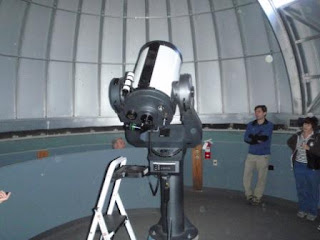 or in Kentucky (1). If our experience of the camp is anything to go by then that is exactly what they get.
 or in Kentucky (1). If our experience of the camp is anything to go by then that is exactly what they get.
The telescope (at left) is a great addition to the camp. The roof opens up and on a clear night campers are able to study the stars and planets.
They also have a leadership program which focuses on developing community leaders who will go back and work in their local communities.
I am sure there are many, many campers who have been inspired by their time at this camp to work in and for their communities.
Subscribe to:
Posts (Atom)

 Posts
Posts


